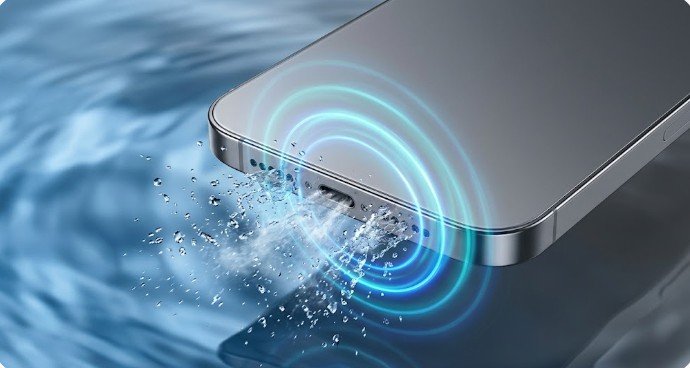
It sounds like snake oil: playing a weird, buzzing tone from a website or app to eject water from your phone. Yet Apple builds this exact concept directly into the Apple Watch, and acoustic physics confirms it works.
Acoustic cleaning works reliably for surface water trapped in speaker ports—provided you understand the mechanics and know its hard limits.
The Micro-Physics: Defeating Surface Tension
When a smartphone takes an unexpected dive into a sink or gets soaked in the rain, water doesn’t necessarily flood the entire chassis. Instead, it hits the speaker grille—a tight mesh perforated with microscopic holes (typically 0.1 mm to 0.3 mm wide).
At that microscopic scale, surface tension turns droplets into rigid liquid plugs:
-
The water beads across the tiny openings, forming an elastic barrier.
-
This liquid membrane dampens the sound waves leaving the driver, making ringtones and voices sound quiet, thin, or completely submerged.
-
The internal speaker diaphragm is still intact, but the sound waves lose high-end energy trying to fight through the liquid barrier.
To clear it, you must overcome the capillary force holding those droplets in place.
Why the 165 Hz – 230 Hz Sweet Spot Matters
Higher pitch does not equal more power. In acoustic engineering, frequency dictates physical driver excursion (the distance the speaker cone travels back and forth).
-
Above 300 Hz: Diaphragm movements become extremely fast but microscopic. There is insufficient physical displacement to create an outward push.
-
Below 150 Hz: Smartphone drivers are simply too small to reproduce sub-bass effectively; they lose efficiency and fail to move significant air volume.
-
The 165–230 Hz Zone: This narrow band triggers maximum linear excursion within safe operational thresholds. The voice coil drives the miniature cone back and forth like a tiny pneumatic pump, creating rapid spikes in positive air pressure directly behind the mesh.
This acoustic pressure exceeds the droplet’s surface tension, shattering the liquid seal and driving droplets out through the mesh perforations.
What Sonic Ejection Can (and Cannot) Fix
| Symptom | Can Sound Waves Fix It? | Root Cause |
| “Underwater” or muffled voice audio | Yes | Droplets suspended inside the mesh apertures acting as a low-pass filter. |
| Crackle on sudden loud alerts | Yes | Water droplets clinging to the outer face of the diaphragm. |
| One side stereo channel quieter | Yes | Isolated moisture plugging one specific grille cluster. |
| Dead silence / zero audio output | No | Burnt-out voice coil or an open circuit. Requires hardware replacement. |
| Distortion persisting after drying | No | Dissolved minerals/salts dried directly onto the voice coil gap, causing friction. |
| Phone submerged over 30 minutes | No | Liquid has likely breached interior gaskets, threatening the logic board. |
The Rice Myth vs. Acoustic Eviction
Throwing a phone into a bowl of uncooked rice remains the most common—and counterproductive—folk remedy.
Rice relies entirely on passive atmospheric desiccation. While it slowly absorbs humidity from the air, it lacks the kinetic energy needed to overcome capillary adhesion in a 0.2 mm hole. Worse, rice introduces fine starch dust that combines with moisture to form a cement-like paste inside your charging port and speaker mesh.
Sonic ejection applies active kinetic force immediately, expelling the liquid before minerals dry and crystallize inside the driver assembly.
How to Execute an Acoustic Purge Correctly
To maximize the effect of a 165–230 Hz sweep:
-
Position downward: Angle the affected speaker array strictly toward the floor. Let gravity pull the displaced droplets down once the sound breaks their surface tension.
-
Dial volume to 100%: Diaphragm displacement directly correlates to signal amplitude. Lower volumes lack the mechanical force to pop the droplets free.
-
Run 45–60 second intervals: Allow the frequency sweep enough cycles to build acoustic pressure across multiple resonance points.
-
Dab immediately: Keep an absorbent, lint-free microfiber cloth resting gently against the outer perimeter to soak up droplets the instant they exit the mesh, preventing them from wicking back inside.