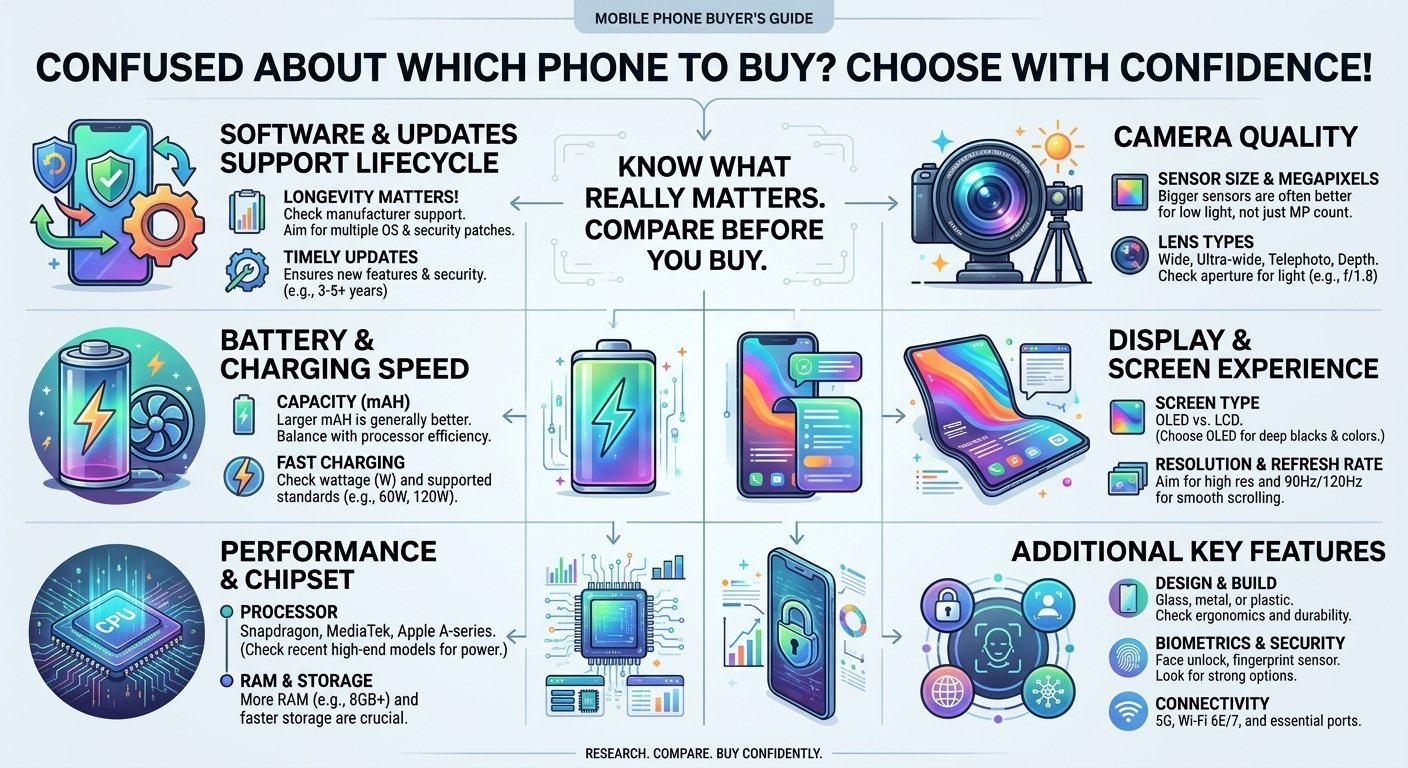
Walk into a store or open an online shop and you will see dozens of phones, each promising the best camera, the fastest chip, and the biggest battery. It is easy to feel overwhelmed. The truth is that you do not need to compare every spec. If you focus on a handful of things that really matter, you can pick a phone you will enjoy for years. Here is a simple guide.
1. Set your budget first
Decide how much you are comfortable spending before looking at models. Phones fall roughly into three groups: budget, mid-range, and flagship. Mid-range phones today offer excellent value, and for many people they are the sweet spot. Remember to include accessories like a case, a screen protector, and possibly a charger in your total.
2. Choose your operating system
The main choice is between iPhone (iOS) and Android. iPhones offer a polished, consistent experience, long software support, and tight integration with other Apple products. Android offers more choice in price, design, and features. If your family and friends use iMessage and FaceTime, or you own a Mac or Apple Watch, an iPhone may feel natural. If you prefer customization and a wider price range, Android is a great fit.
3. Check how long software updates are promised
This is one of the most overlooked factors. A phone that receives security and system updates for five or more years will stay safe and fast much longer than one that is abandoned after two. Before buying, search for the manufacturer’s update policy for that exact model.
4. Look at the display
A good screen makes everything better. Look for an OLED or AMOLED panel for deeper blacks and better colors, and consider a refresh rate of 90Hz or 120Hz for smoother scrolling. Brightness matters if you often use the phone outdoors. Do not worry too much about extreme resolutions, because the difference is hard to notice on a phone-sized screen.
5. Understand performance without the hype
The processor and RAM decide how smooth the phone feels. For everyday use like messaging, social media, and video, a mid-range chip is enough. If you play demanding games or edit video, choose a more powerful processor and at least 8GB of RAM. Be wary of marketing numbers, and rely on real-world reviews and benchmarks.
6. Choose enough storage
Storage is hard to upgrade later. For most people, 128GB is a reasonable starting point, while 256GB is better if you take lots of photos and video, install many games, or keep your phone for several years. If you use cloud storage regularly, you may get away with less.
7. Judge battery life and charging
A bigger battery number in mAh is helpful, but efficiency matters too, so read battery tests in reviews. Check the charging speed and whether a charger is included in the box, since many brands no longer include one. Wireless charging is a nice extra if it matters to you.
8. Do not judge the camera by megapixels
More megapixels do not automatically mean better photos. Sensor size, lens quality, and image processing matter much more. The best way to judge a camera is to look at real sample photos and video from reviewers, especially in low light. Decide which cameras you will actually use, because a great main camera is worth more than several mediocre extras.
9. Consider build quality and size
Glass and metal feel premium, while plastic is lighter and often tougher. Check the water-resistance rating if you want extra protection. Also think about size and weight, since a very large phone may be uncomfortable to hold for long periods. If you can, try one in a store.
10. Check network and connectivity features
Make sure the phone supports the network bands used by your carrier and 5G where available in your area. If you travel, dual-SIM or eSIM support can be very useful. Features like NFC, Wi-Fi 6 or newer, and a headphone jack may matter depending on your habits.
11. Think about new versus refurbished
Certified refurbished phones from reputable sellers can offer flagship quality at a lower price, often with a warranty. Be careful with unknown sellers, and always check warranty, battery condition, and return policy.
12. Read reviews and compare
Before buying, read trusted reviews and user feedback, and compare two or three shortlisted models side by side. Look for long-term reviews, because they reveal issues that do not appear in a first-impressions video.
Quick checklist before you buy
- Does it fit my budget, including accessories?
- How many years of updates will it get?
- Is the screen good in sunlight and smooth to use?
- Is the battery life proven in reviews?
- Is the storage enough for at least three years?
- Does it work well on my network?
- Is there a good warranty and local service?
Final thoughts
The best phone is not the most expensive one. It is the one that fits your budget, your habits, and the next few years of your life. Focus on software support, battery, display, and real-world performance, and you will make a choice you will be happy with.